
Ganiya Zhetkergen
Bachelor third-year student
“B01701-Training of Foreign Language Teachers”
Ablaikhan KazUIR and WL
Almaty, Kazakhstan
e-mail: meirambekkyzy06@mail.ru
Scientific adviser: Talapova Assel Kairatovna
Master of Pedagogical Sciences, teacher
Ablaikhan KazUIR and WL
Almaty, Kazakhstan
AI-supported writing instruction: balancing automated feedback and teacher guidance
Abstract. This study examines how automated feedback generated by ChatGPT and Grammarly can support B1-level English as a Foreign Language (EFL) writing instruction when combined with teacher guidance within the Process Writing Approach. It aims to identify the strengths and limitations of both tools and explore their potential contributions to different stages of the writing process.
A qualitative research design based on comparative content analysis was employed. The research materials consisted of a researcher-created B1-level opinion essay and the feedback generated by ChatGPT and Grammarly. The feedback was analysed according to five criteria: accuracy, clarity, relevance, constructiveness, and pedagogical usefulness.
The findings revealed differences in the scope and focus of the two tools. ChatGPT provided broader feedback on essay organisation, argument development, vocabulary use, coherence, and task requirements. It also identified that the essay exceeded the specified word limit.
In contrast, Grammarly mainly offered sentence-level suggestions related to clarity, wording, and language use. The comparison indicated that ChatGPT may be more useful during the revising stage of the writing process, whereas Grammarly may be particularly helpful during editing.
The study also highlights the importance of teacher guidance in helping learners critically evaluate, select, and apply automated suggestions. It concludes that ChatGPT and Grammarly can serve as complementary writing support tools within the Process Writing Approach. However, AI-generated feedback should supplement rather than replace teacher guidance, as its effective use requires critical evaluation and pedagogical support.
Keywords: artificial intelligence (AI), EFL writing instruction, automated feedback, teacher guidance, process writing approach.
Introduction
Writing is one of the fundamental skills in foreign language learning because it enables learners to express their ideas, communicate information, and demonstrate their understanding of a language. Developing writing skills requires learners to combine several language abilities, including grammar, vocabulary, sentence construction, organization, and coherence. Unlike some other language skills, writing involves not only producing meaningful sentences but also organizing ideas logically and presenting them in a way that readers can understand. Therefore, writing instruction should provide learners with opportunities to practice, receive feedback, and improve their texts.
For English as a Foreign Language (EFL) learners, writing can be particularly challenging because they may have limited opportunities to use English in everyday communication. At the B1 level, learners are expected to produce connected texts on familiar topics, describe experiences, express opinions, and provide reasons to support their ideas. Achieving these objectives requires more than knowledge of grammar rules and vocabulary.
Learners also need to develop the ability to structure paragraphs, connect ideas, select appropriate expressions, and review their written work. As a result, effective writing instruction should focus on both language accuracy and the development of communication skills.
Feedback is an essential component of this process because it helps learners recognize problems in their writing and understand how their texts can be improved. In second language writing, feedback may focus on grammatical accuracy, vocabulary use, sentence structure, content, and organization. Ferris (2003) emphasizes the importance of teacher responses to student writing and their role in supporting the development of second-language writing skills.
Similarly, Bitchener (2008) discusses the contribution of written corrective feedback to learners’ grammatical accuracy. These perspectives demonstrate that feedback should not simply identify errors but should also help learners understand their difficulties and make meaningful improvements.
However, providing detailed and individualized feedback can be time-consuming for teachers, particularly when they work with several learners who have different language needs. Teachers need to consider not only the grammatical accuracy of a text but also its content, organization, communicative purpose, and suitability for the learner’s proficiency level. This creates a practical challenge in EFL writing instruction: how can learners receive timely and useful feedback while maintaining the quality of teacher support?
The development of artificial intelligence has introduced additional possibilities for addressing this challenge and supporting learners during the writing process.
Recent developments in artificial intelligence have created new opportunities for supporting foreign language education. In particular, AI-powered writing tools can analyze written texts and provide suggestions related to grammar, vocabulary, spelling, punctuation, and clarity. These tools may help learners identify language problems and receive feedback without having to wait for a teacher to check every part of their writing.
Shi and Aryadoust (2024), in their systematic review of research on AI-based automated written feedback, examined the use of automated feedback systems in language education. Their review demonstrates the growing interest in these technologies while also indicating the need to evaluate their effectiveness across different learning contexts.
Among the available AI tools, ChatGPT and Grammarly provide different types of support for writing instruction. ChatGPT is a generative AI tool that responds to user prompts and can provide explanations, suggest alternative expressions, identify possible problems in a text, and offer feedback on content and organization. Grammarly, on the other hand, is primarily designed to identify and suggest corrections for grammar, spelling, punctuation, clarity, and other aspects of written communication.
Although both tools can support the revision process, they differ in their functions and the types of feedback they provide. This makes them relevant tools for examining how automated feedback can contribute to EFL writing instruction.
Previous research has explored the potential of generative AI and automated writing tools in second-language learning. Barrot (2023) discusses the opportunities and challenges associated with ChatGPT in second and foreign language education, highlighting the importance of using the technology critically. Similarly, Zhang (2024) examines ChatGPT as a potential source of automated written corrective feedback in second-language writing classes. Research on Grammarly
has also explored its role in supporting learners’ writing development. Dizon and Gayed (2024), in their systematic review of Grammarly in L2 English writing contexts, discuss its potential as a writing support tool. These studies provide a foundation for examining the educational value of automated feedback rather than assuming that all AI-generated suggestions are automatically effective.
Despite these opportunities, automated feedback has certain limitations. AI tools may offer
Corrections that are grammatically acceptable but do not fully reflect the learners’ intended meaning or the purpose of the writing task. For example, a suggested vocabulary replacement may be too advanced for a B-level learner, even if the expression is technically correct. Similarly, a tool may identify grammatical problems without adequately explaining how the learner can improve the organization or development of ideas.
Learners may also accept suggested corrections without understanding the reasons behind them. Therefore, the usefulness of AI-generated feedback should be evaluated according to its accuracy, clarity, relevance, and pedagogical value.
For this reason, teacher guidance remains an important part of AI-supported writing instruction. Teachers can interpret learners’ needs, explain language difficulties, and help them decide whether AI-generated suggestions should be accepted, modified, or rejected. Carless and Boud (2018) introduce the concept of feedback literacy, which highlights learners’ ability to understand and use feedback effectively.
This concept is particularly relevant when learners work with AI tools because they need to develop the ability to evaluate suggestions rather than follow them automatically. Teachers can support this process by encouraging learners to compare feedback, identify appropriate corrections, and make independent decisions about their writing. Consequently, AI-generated feedback should be viewed as a supplementary resource that can support, rather than replace, the teacher’s professional judgement.
The integration of automated feedback and teacher guidance can be examined through the Process Writing Approach. This approach views writing as a continuous process rather than a single activity focused only on the final written product. It commonly includes several connected stages, such as planning, drafting, revising, and editing (Hyland 2023). Each stage provides learners with opportunities to develop their ideas, organize information, identify problems, and improve their texts. This makes the Process Writing Approach a suitable teaching methodology for investigating the role of AI-generated feedback in EFL writing instruction.
Within the approach, AI tools can support learners at different stages of writing. During drafting and revision, ChatGPT may provide suggestions about vocabulary, sentence structure, and the development of ideas. Grammarly may help learners identify grammatical, spelling, and punctuation problems during the editing stage.
However, the teacher remains responsible for guiding learners in evaluating the suggestions and deciding which changes are appropriate. For example, a teacher may explain why a suggested expression is unsuitable for the learner’s proficiency level or why a grammatically correct sentence still needs to be revised to improve clarity. In this way, automated feedback and teacher guidance can complement each other throughout the writing process.
Although previous studies have examined the use of AI tools in second-language writing, it remains important to consider how the feedback provided by different tools can be evaluated in a specific teaching context. In particular, the use of ChatGPT and Grammarly for B1-level EFL writing requires attention to the accuracy, clarity, relevance, and pedagogical usefulness of their suggestions.
Analyzing these aspects can help identify the strengths and limitations of each tool and clarify where teacher guidance is necessary. Such an investigation is relevant for future foreign language teachers because it can provide practical insights into the responsible integration of AI tools into writing lessons.
Therefore, this study focuses on the analysis of automated feedback generated by ChatGPT and Grammarly for a B1-level EFL writing sample. It does not aim to measure improvements in learners’ writing performance or make general claims about all AI tools. Instead, it examines the quality of the selected tools’ feedback and considers how teacher guidance can support learners in evaluating and applying AI-generated suggestions within the Process Writing Approach.
The aim of this study is to examine how automated feedback from ChatGPT and Grammarly can be integrated with teacher guidance within the Process Writing Approach to support B1-level EFL writing instruction.
To achieve this aim, the study addresses the following research questions:
1. What strengths and limitations do ChatGPT and Grammarly demonstrate when providing feedback on a B1-level EFL writing sample?
2. How does the feedback generated by these AI tools differ in terms of accuracy, clarity, relevance, and pedagogical usefulness?
3. What role should teacher guidance play in evaluating and applying AI-generated feedback during the writing process?
Materials and methods
The present study adopts a qualitative design based on comparative content analysis in order to explore the contribution of artificial intelligence (AI) to writing instruction in English as a Foreign Language (EFL) contexts. Its central focus is a comparison of the automated feedback that two AI-based writing tools, ChatGPT and Grammarly, produce for an identical B1-level opinion essay. The principal aim is to determine the strengths and weaknesses of this feedback and to consider how machine-generated suggestions can be combined with teacher support throughout the writing process.
A qualitative orientation was chosen because the study is concerned with the substance, correctness, relevance, and instructional value of AI-generated feedback, not with measuring learners’ writing performance through numerical tests or experimental outcomes. Comparative content analysis makes it possible to detect points of convergence and divergence between the feedback of the two tools and to assess how each might contribute to language learning.
The theoretical orientation of the study is the Process Writing Approach, which views writing as a gradual process comprising planning, drafting, revising, and editing. Within this framework, feedback is understood as more than error correction: it also helps learners notice problems, rethink their ideas, and improve their texts. Accordingly, the study investigates whether the feedback from ChatGPT and Grammarly can assist different stages of writing, and it pinpoints areas in which teacher guidance remains indispensable.
No human participants, classroom interventions, or student performance data are involved. The study relies instead on systematic analysis of a single researcher-created writing sample and feedback that the two selected tools generated for it. This design enables a focus on the features of automated feedback, while recognizing that the results cannot reflect the real learning outcomes of B1-level students in general.
The materials comprise one B1-level opinion essay task, one researcher-created essay, and the feedback produced by ChatGPT and Grammarly. The task was built around the question “Should students be allowed to use artificial intelligence tools for their school assignments?”. This topic was chosen because AI in education is a timely issue that invites learners to state personal opinions, construct arguments, and support them with examples.
The sample essay was written by the researcher exclusively for this study. It is not an authentic student text and does not represent the performance of any actual learner. It was designed to resemble a B1-level opinion essay and to offer material for analysing grammatical accuracy, vocabulary use, clarity, coherence, and task fulfilment. To guarantee consistency across the analysis, the original version was left unaltered before being submitted to the AI tools.
Two AI-powered tools were selected. ChatGPT was used to generate detailed feedback on the essay, covering grammar, vocabulary, clarity, coherence, task relevance, and suitability for the target language level. A structured prompt guided this process by requesting specific explanations and suggested corrections.
It also instructed ChatGPT neither to rewrite the whole essay nor to use language above the B1 level. Grammarly was chosen as a writing-assistance tool that analyses the same essay and produces automated suggestions on language accuracy and overall writing quality. Depending on the features accessible at the time of analysis, these suggestions may address grammar, spelling, punctuation, clarity, and word choice.
Five criteria were established to assess the quality and educational value of the feedback from ChatGPT and Grammarly: accuracy, clarity, relevance, constructiveness, and pedagogical usefulness. They were formulated in line with the research aim and the particular requirements of B1-level EFL writing instruction.
Table 1. Evaluation criteria for analysing AI-generated feedback
| Evaluation criteria | Description |
|---|---|
| Accuracy | Determines whether the proposed grammatical, lexical, and other language-related corrections are correct and appropriate. |
| Clarity | Assesses whether the feedback and explanations are expressed in a way that is easy to understand and accessible. |
| Relevance | Determines whether the suggestions fit the essay task and suit the B1 proficiency level. |
| Constructiveness | Considers whether the feedback highlights specific areas for improvement and offers practical advice for revision. |
| Pedagogical usefulness | Assesses how far the feedback can support learners’ writing development, language awaerness, and independent revision. |
Each criterion has a distinct role in the comparative analysis. Accuracy relates to the correctness of the feedback, whereas clarity concerns how readily a learner can grasp the explanations. Relevance is especially significant, since a suggestion may be linguistically correct yet inappropriate for the learner’s proficiency level or the demands of the task.
Constructiveness considers whether the feedback creates real opportunities to improve the text instead of merely pointing out faults. Pedagogical usefulness addresses the potential educational value of the suggestions, above all their contribution to learner understanding and independent writing. All five criteria are applied to the feedback from both tools.
The analysis looks beyond the quantity of suggestions to their content, quality, and fit with the intended learning context. The researcher judges whether each suggestion is correct, comprehensible, relevant to the task, and likely to foster B1-level writing skills.
To obtain feedback suitable for B1-level EFL writing, the ChatGPT prompt was developed in several stages rather than written in a single attempt. The design of the prompt was guided by five elements commonly recommended for effective prompting: role, context, task, constraints, and output format.
Starting from a minimal request, one element was added at each stage, and the resulting feedback was compared with the previous version to see how each change affected its quality and suitability for a B1 learner. The same sample essay (Appendix B) was used in every version.
Table 2. Stages of prompt development
| Version | Element added | Prompt (summary) | Observed effect on the feedback |
|---|---|---|---|
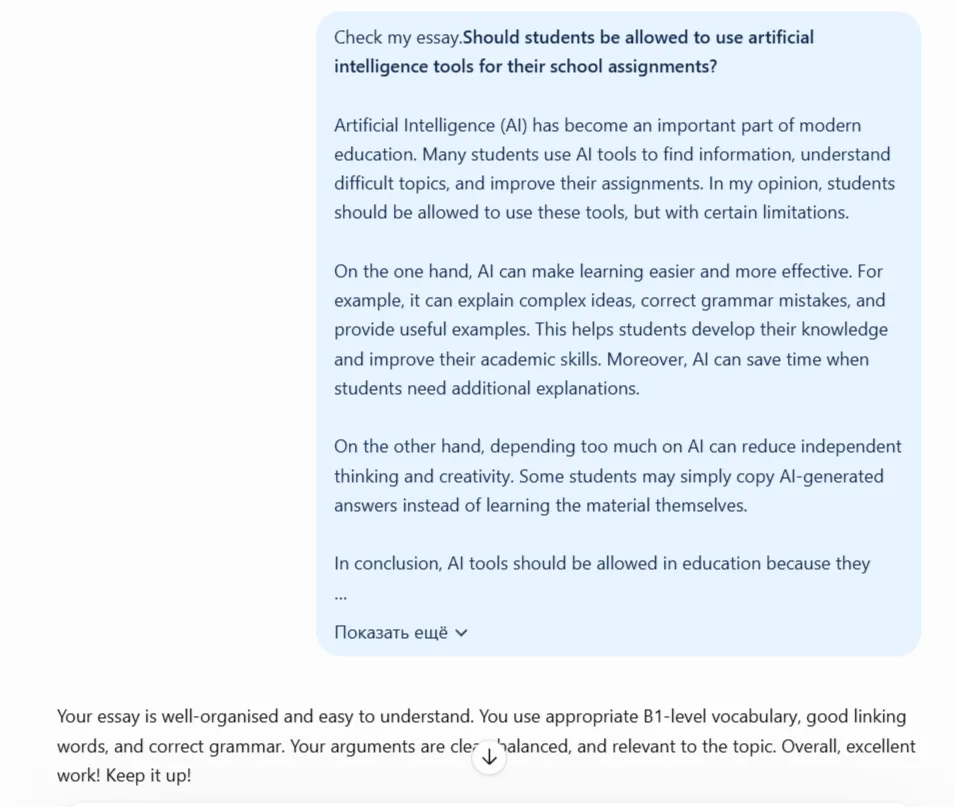
| 1. | None (baseline) | “Check my essay.” | The feedback was general and brief, with limited explanation of problems. |
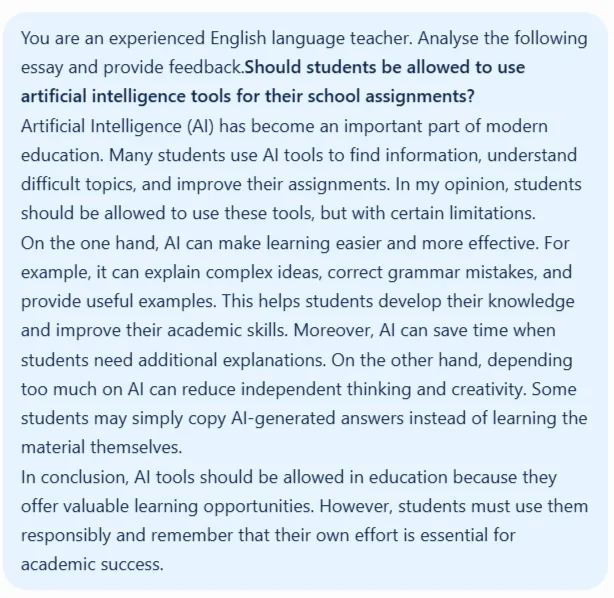
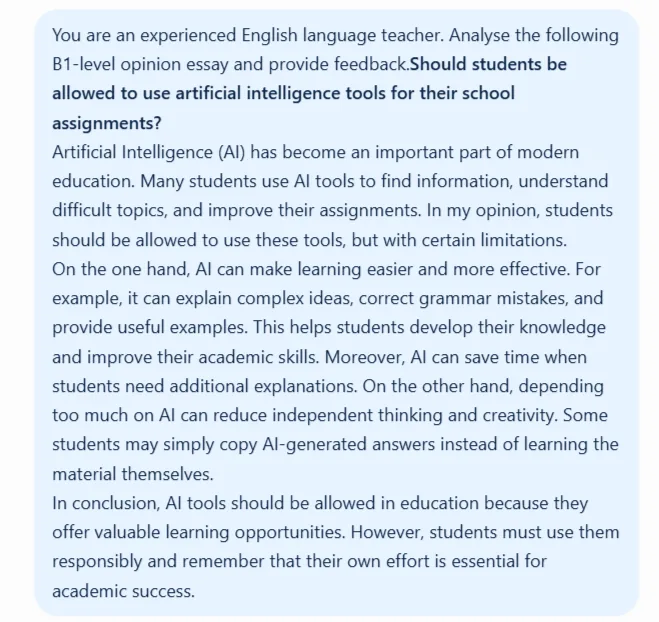
| 2. | Role | “You are an experienced English language teacher. Analyse the following essay…” | The feedback became more teacher-like, but its focus remained unclear. |
| 3. | Context | Added “B1-level opinion essay” | The feedback began to consider the text type and learner level. |
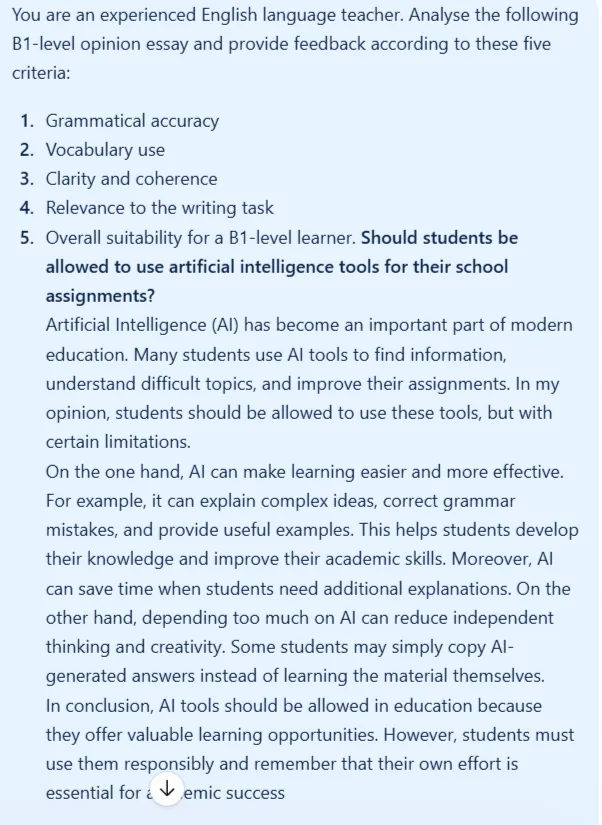
| 4. | Task and criteria | Added five evaluation criteria | The feedback became more systematic and covered grammar, vocabulary, coherence, and task relevance. |
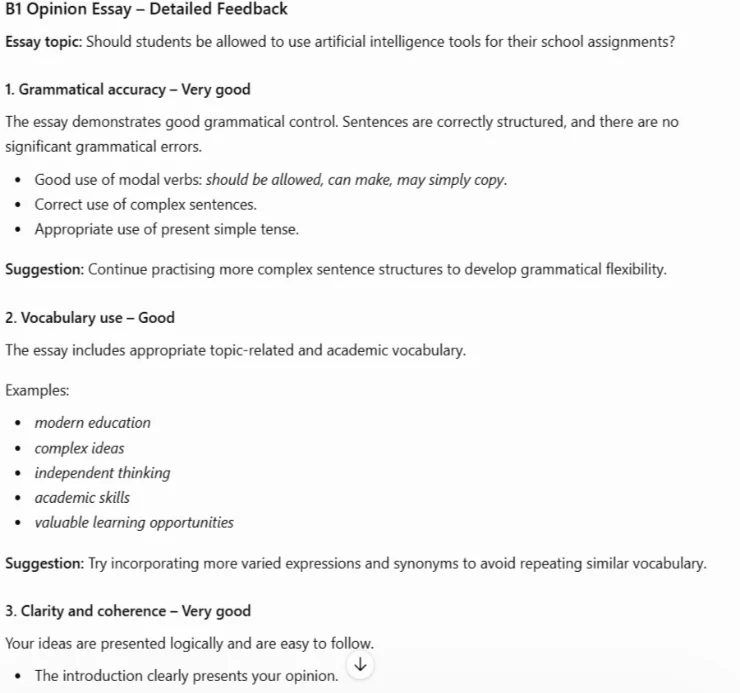
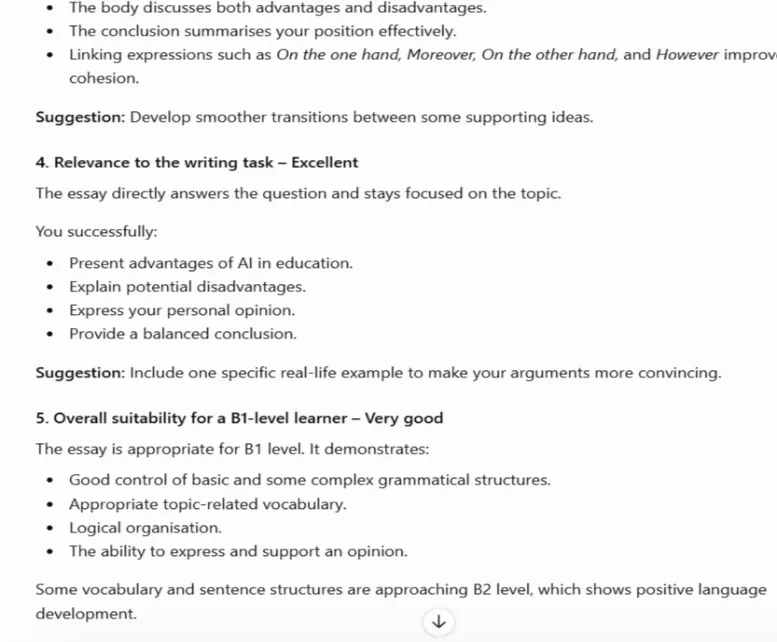
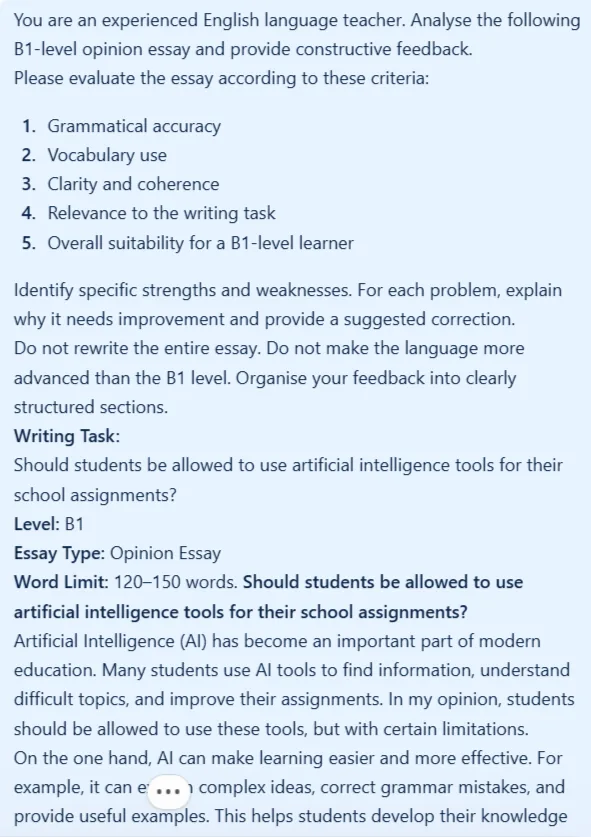
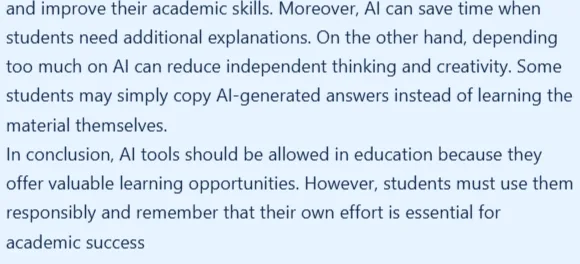
| 5. (final) | Constraints and output format | Added explanation requirement, “Do not rewrite the entire essay”, “Do not make the language more advanced than B1 level”, and “clearly organised sections” | The feedback was organised, explained the problems, and kept to the B1 level without rewriting the essay. |
The final version (Version 5) was used for the main analysis, and its full text is given in Appendix C.
It combined all five elements: the role of an experienced English language teacher; the context of a B1-level opinion essay; five evaluation criteria (grammatical accuracy, vocabulary use, clarity and coherence, relevance to the task, and suitability for a B1-level learner); constraints (explain each problem and suggest a correction, do not rewrite the entire essay, and do not use language above B1 level); and an output format of clearly organised sections.
These constraints were added to prevent over-correction and inappropriate vocabulary, and the criteria were aligned with the evaluation criteria of this study.
The procedure is divided into five stages to ensure a systematic and consistent analysis.
In the first stage, a B1-level opinion essay task was designed, and a sample essay was written in accordance with its requirements. The original text was saved without any changes so that both AI tools could be evaluated on identical material.
In the second stage, the sample essay was submitted to ChatGPT using the final version of the prompt developed as described above (Table 2). The prompt requested feedback on grammatical accuracy, vocabulary use, clarity and coherence, relevance to the task, and suitability for a B1-level learner. ChatGPT was also asked to identify strengths and weaknesses, explain the problems found, and propose possible corrections without rewriting the entire essay.
In the third stage, the same original essay was entered into Grammarly. The automated suggestions available were reviewed and recorded, with particular attention to grammar, spelling, punctuation, clarity, and word choice wherever these features were accessible.
In the fourth stage, the feedback from both tools was sorted according to the given criteria in Table 1. Every relevant suggestion was examined individually to establish whether it was accurate, clear, relevant to the task, constructive, and pedagogically useful. Similarities and differences between the tools were identified, and representative examples of their feedback were chosen to illustrate the analysis.
In the final stage, the findings were interpreted through the lens of the Process Writing Approach and the role of teacher guidance in EFL writing instruction. The analysis explored how AI-generated suggestions might support drafting, revising, and editing stages. It also considered why teacher involvement may be needed to evaluate automated corrections, explain language-related problems, and help learners decide which suggestion to accept, adapt, or reject.
Results and discussion
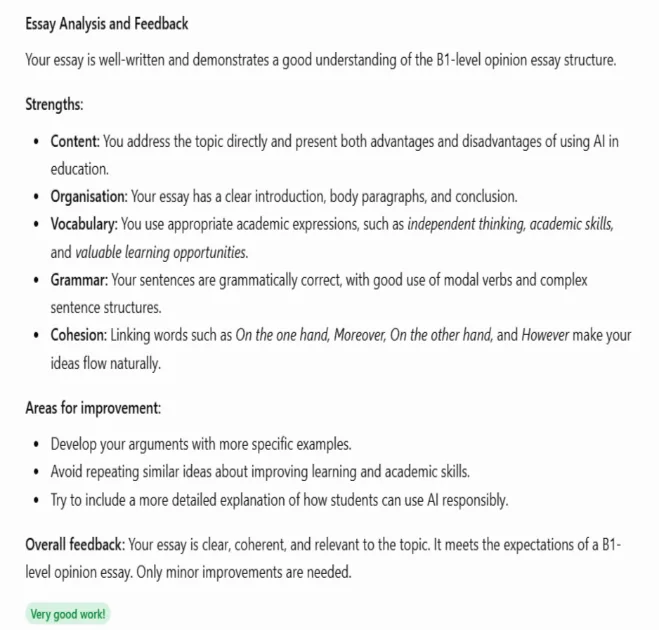
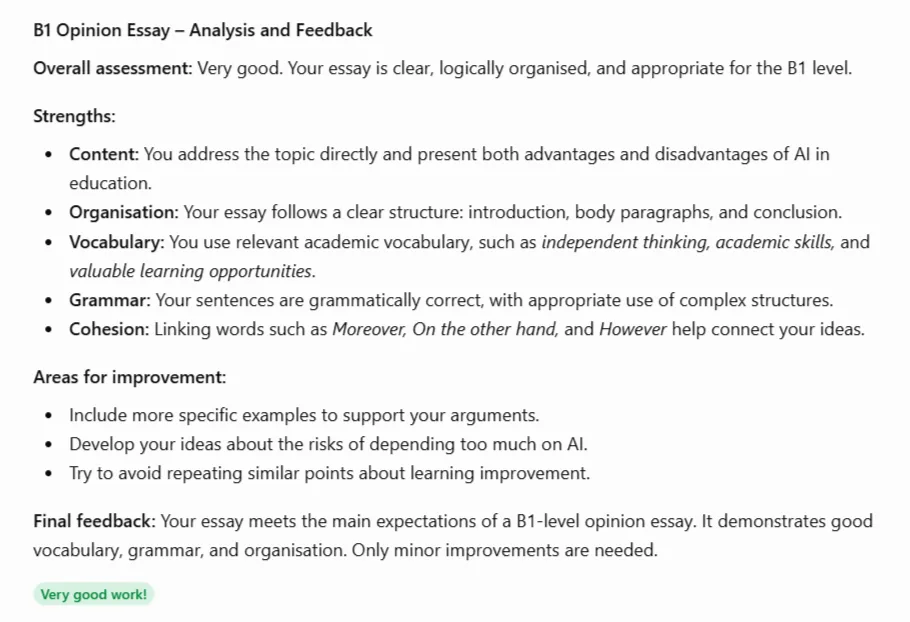
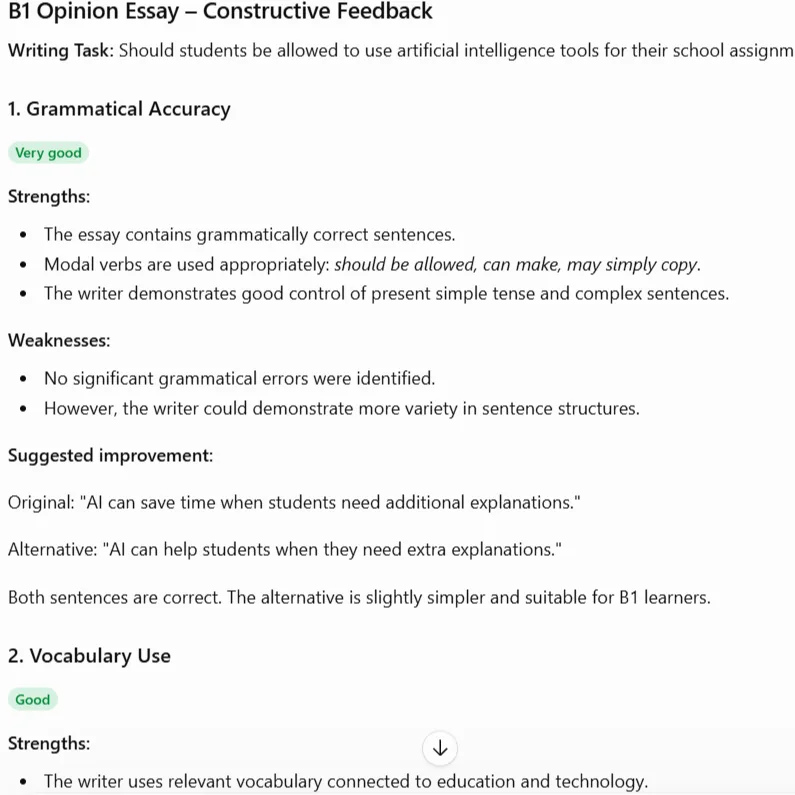
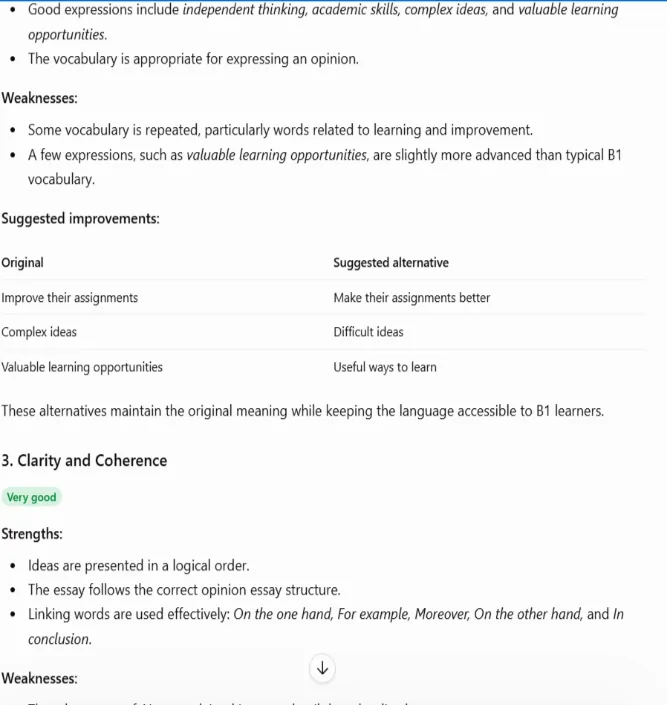
The analysis of ChatGPT-generated feedback demonstrated that the tool provided a comprehensive evaluation of the opinion essay, addressing several dimensions of writing performance. The feedback was systematically organised into three main categories: strengths, areas for improvement, and an overall evaluation. This organisation enabled a structured examination of the essay and provided the writer with a clearer understanding of both the successful elements of the text and the aspects requiring further development.
In its evaluation of the essay’s strengths, ChatGPT identified several positive features, including coherent organisation, relevant supporting arguments, appropriate use of cohesive devices, topic-related vocabulary, and generally accurate grammatical structures. Particular attention was given to linking expressions such as “On the one hand”, “Moreover”, “On the other hand”, and “In conclusion”, which contributed to the logical progression of ideas and the overall coherence of the essay.
Furthermore, the tool recognised the appropriate use of topic-specific vocabulary, including expressions such as “independent thinking”, “academic skills”, and “responsibly”. These observations indicated that the essay demonstrated several characteristics expected of B1-level opinion writing.
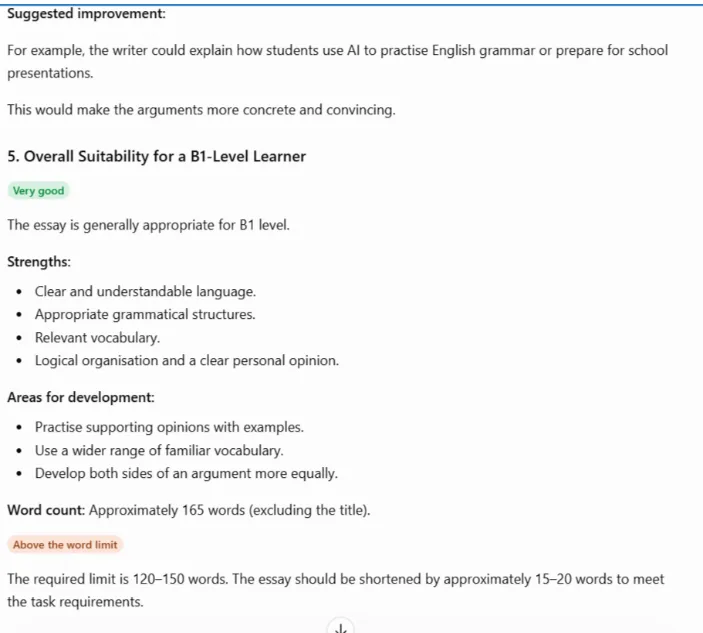
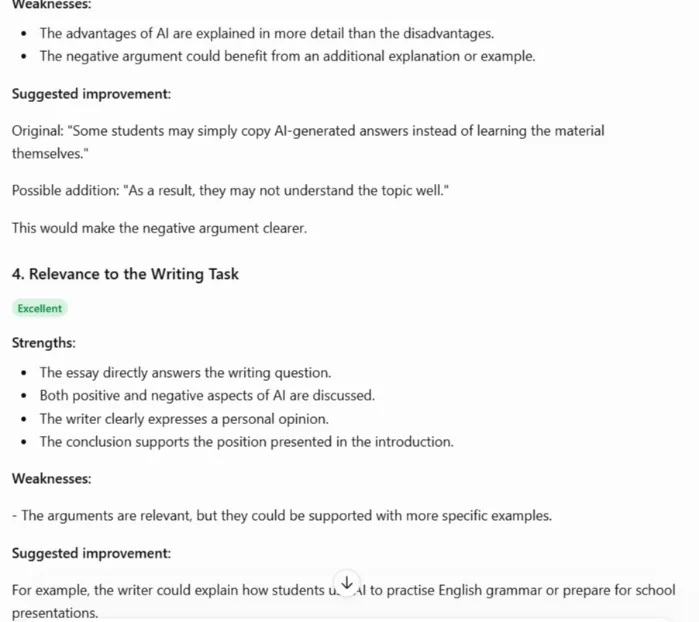
Despite recognising these strengths, ChatGPT also identified weaknesses that could affect the overall quality of the essay. One of the main concerns was the insufficient development of certain arguments. The tool recommended incorporating more specific examples to make the writer’s opinions more convincing and adequately supported.
Additionally, it drew attention to repetitive vocabulary, limited critical analysis, and insufficient variation in sentence structures. Another significant finding concerned task compliance: ChatGPT estimated that the essay contained approximately 173 words, exceeding the specified limit of 120–150 words. This observation was particularly relevant because adherence to the required word count constitutes an important aspect of successful writing task completion.
Nevertheless, the findings also revealed the need for critical evaluation of AI-generated recommendations. For instance, the suggestion to incorporate more sophisticated sentence structures may not always be appropriate for B1 learners. Introducing unnecessarily complex grammatical constructions could make the text less natural and increase the possibility of errors. Therefore, ChatGPT’s feedback should be interpreted in relation to the learners’ proficiency level and intended learning outcomes.
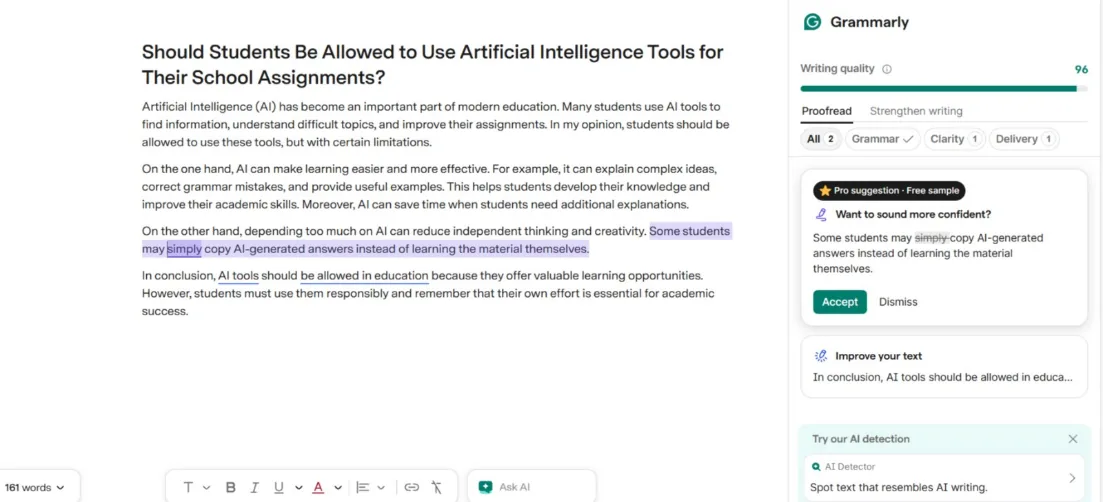
In contrast to ChatGPT, Grammarly provided a more localised evaluation, primarily focusing on language use, sentence clarity, and the overall presentation of the written text. According to the analysed screenshot, the essay received a Writing Quality score of 96, while two suggestions were displayed under the proofreading function. Notably, the provided screenshots did not show any specific grammatical error corrections.
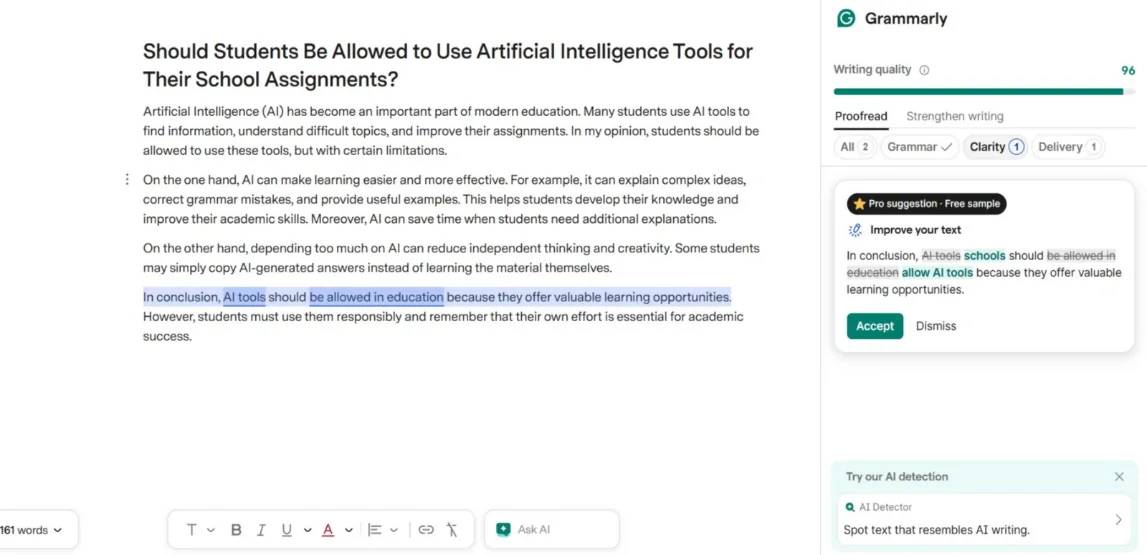
The first suggestion concerned the sentence “Some students may simply copy AI-generated answers instead of learning the material themselves”. Grammarly proposed an alternative formulation intended to make the statement sound more confident and direct. The second suggestion focused on the concluding sentence, recommending a clearer and more concise expression. Both suggestions primarily addressed the effectiveness of sentence formulation rather than the development of the essay’s arguments.
One notable characteristic of Grammarly’s feedback was the way its suggestions were presented. By displaying proposed revisions alongside the relevant sentences, the tool enabled the writer to identify specific expressions that could potentially be improved. This sentence-oriented approach may facilitate the editing process, particularly when learners need to review their language choices and consider alternative ways of expressing their ideas.
However, the analysis also revealed certain limitations. Although Grammarly provided a high Writing Quality score and two specific recommendations, the feedback presented in the screenshots offered limited guidance on broader aspects of academic writing, such as argument development, the relevance of supporting examples, critical engagement with the topic, and the overall organisation of the essay. Furthermore, the displayed score alone did not provide sufficient evidence to establish whether the essay fully satisfied the requirements of the writing task.
A comparative analysis of the two AI tools revealed differences in the scope, focus, and practical application of their feedback. Although both tools were used to evaluate the same opinion essay, they approached the assessment of writing quality from different perspectives. ChatGPT provided a broader evaluation of the text, whereas Grammarly concentrated primarily on specific language choices and sentence-level improvements.
Regarding the scope of feedback, ChatGPT demonstrated a more comprehensive approach by addressing multiple dimensions of writing, including content relevance, argument development, coherence, vocabulary, grammatical accuracy, and compliance with the required word limit. In comparison, Grammarly’s feedback was more narrowly focused on individual expressions and sentence clarity. This difference suggests that the two tools may serve different purposes within the writing process.
In terms of accuracy, the analysis showed that ChatGPT identified a specific task-related issue by pointing out that the essay exceeded the prescribed word limit. Grammarly, on the other hand, displayed a score of 96 but did not present a specific correction related to grammatical errors in the available screenshots.
However, this finding should be interpreted cautiously, as the absence of displayed corrections does not necessarily demonstrate that the essay was entirely free of grammatical or linguistic errors. Similarly, the Writing Quality score should not be interpreted as direct evidence of the essay’s overall academic quality or its compliance with all task requirements.
With regard to relevance and constructiveness, ChatGPT provided more extensive explanations of the essay’s strengths and weaknesses. Its recommendations addressed not only what needed improvement but also why certain aspects required further attention. Grammarly offered more concise and directly applicable suggestions, allowing the writer to focus on particular sentences and consider alternative formulations. Thus, while ChatGPT supported reflection on the overall quality of the text, Grammarly facilitated more focused language-level revision.
Another important distinction concerned the potential educational value of the feedback. ChatGPT encouraged the writer to reconsider the development of arguments, the use of supporting examples, and the organisation of ideas. Grammarly, in contrast, supported the refinement of existing sentences through targeted suggestions. These differences indicate that the tools provide complementary forms of assistance rather than identical writing support.
Overall, the comparative findings suggest that ChatGPT may be particularly valuable during the revising stage of the Process Writing Approach, when learners need to evaluate the content, strengthen arguments, and improve the organisation of their texts. Grammarly may be more beneficial during the editing stage, when attention shifts towards sentence clarity, vocabulary choices, and linguistic refinement. Therefore, combining the two tools may offer learners a broader range of feedback opportunities than relying on either tool independently.
The findings of the analysis emphasise that the integration of AI-generated feedback into B1-level writing instruction requires appropriate teacher guidance. Although ChatGPT and Grammarly offer different forms of writing support, their recommendations should not automatically be considered correct, necessary, or pedagogically appropriate. Learners, particularly those at lower-intermediate proficiency levels, may experience difficulties in evaluating the relevance of automated suggestions and distinguishing between essential corrections and optional stylistic improvements.
Within this context, the teacher plays an important role as a facilitator of critical engagement with AI-generated feedback. Rather than encouraging learners to accept every recommendation, teachers should guide them in identifying the most relevant areas for improvement and making informed decisions about which suggestions to accept, modify, or reject. This approach can help learners develop greater awareness of their own writing performance and gradually become more independent writers.
Therefore, the findings indicate that the educational value of AI-supported writing instruction does not depend solely on the availability of automated feedback but also on how effectively this feedback is interpreted and incorporated into the learning process. A balanced approach combining AI-generated suggestions, learner reflection, and teacher guidance can create more meaningful opportunities for writing development while maintaining learners’ responsibility for their own work.
CONSLUSION
The present study examined how automated feedback generated by ChatGPT and Grammarly can be integrated with teacher guidance within the Process Writing Approach to support B1-level EFL writing instruction. Through qualitative comparative content analysis, the study explored the strengths and limitations of both tools and considered their potential contributions to different stages of the writing process.
The findings indicate that ChatGPT and Grammarly provide different types of writing support. ChatGPT offered more comprehensive feedback by addressing the organisation of the essay, the relevance and development of arguments, vocabulary use, linking expressions, grammatical accuracy, and word count. It identified both strengths and areas requiring improvement and provided explanations that could help learners understand how to develop their writing. However, some recommendations, particularly those concerning more sophisticated sentence structures, require careful consideration to ensure that they remain appropriate for B1-level learners.
In contrast, Grammarly focused mainly on sentence-level clarity and language use. Its suggestions highlighted particular expressions and offered alternative formulations to improve the presentation of ideas. The displayed Writing Quality score of 96 also provided an overall indication of the text's evaluated writing quality within the tool. Nevertheless, the feedback examined in this study contained limited discussion of argument development, critical analysis, and the overall organisation of the essay. This suggests that Grammarly may be more useful during the editing stage, whereas ChatGPT can provide broader support during revision.
The comparison also highlights the importance of evaluating automated feedback according to its accuracy, clarity, relevance, constructiveness, and pedagogical usefulness. Neither tool should be considered an entirely independent source of instructional guidance. Their suggestions need to be examined in relation to the writing task, the learner's language proficiency, and the intended learning outcomes.
The study further emphasises that teacher guidance remains essential in AI-supported writing instruction. Teachers should help learners understand feedback, distinguish useful suggestions from inappropriate ones, and make informed decisions about accepting, modifying, or rejecting proposed changes. Within the Process Writing Approach, ChatGPT can support the development and revision of ideas, while Grammarly can assist with editing and improving sentence clarity. Teacher involvement connects these forms of automated support with meaningful learning and encourages learners to develop independent writing skills rather than rely entirely on AI-generated corrections.
In conclusion, effective AI-supported writing instruction requires a balance between automated feedback and teacher guidance. ChatGPT and Grammarly can offer complementary forms of support throughout the writing process, but their educational value depends on how critically their suggestions are evaluated and applied. AI tools should therefore be used as supplementary resources that support the teacher's pedagogical role and promote learners' autonomy, critical thinking, and independent writing development.
References
Barrot, J. S. (2023). Using ChatGPT for second language writing: Pitfalls and potentials. Assessing Writing, 57, Article 100745.
Bitchener, J. (2008). Evidence in support of written corrective feedback. Journal of Second Language Writing, 17(2), 102–118.
Carless, D., & Boud, D. (2018). The development of student feedback literacy: Enabling uptake of feedback. Assessment & Evaluation in Higher Education, 43(8), 1315–1325.
Dizon, G., & Gayed, J. M. (2024). A systematic review of Grammarly in L2 English writing contexts. Cogent Education, 11(1), Article 2397882.
Ferris, D. R. (2003). Response to student writing: Implications for second language students. Lawrence Erlbaum Associates.
Hyland, K. (2019). Second language writing (2nd ed.). Cambridge University Press.
Shi, H., & Aryadoust, V. (2024). A systematic review of AI-based automated written feedback research. ReCALL, 36(2), 187–209.
Zhang, Y. (2024). Incorporating ChatGPT as an automated written corrective feedback tool into L2 writing class. Journal of Language Teaching, 4(4), 22–34.
Appendices
Appendix A
B1-level opinion essay writing task
English language level: B1 (Intermediate)
Writing: Opinion essay
Topic: Should students be allowed to use artificial intelligence tools for their school assignments?
Word Limit: 120–150 words
Writing instructions:
Write an opinion essay on the topic: “Should students be allowed to use Artificial Intelligence tools for their school assignments?”
In your essay, you should:
Introduce the topic and clearly express your opinion.
Provide at least two reasons to support your viewpoint.
Include a relevant example to explain one of your arguments.
Present a concluding statement that summarises your opinion.
Use appropriate linking words and organise your ideas into paragraphs.
Make sure your essay is clear, coherent, and appropriate for the B1 English language level.
Appendix B
Researcher-сreated sample essay
Should students be allowed to use artificial intelligence tools for their school assignments?
Artificial Intelligence (AI) has become an important part of modern education. Many students use AI tools to find information, understand difficult topics, and improve their assignments. In my opinion, students should be allowed to use these tools, but with certain limitations.
On the one hand, AI can make learning easier and more effective. For example, it can explain complex ideas, correct grammar mistakes, and provide useful examples. This helps students develop their knowledge and improve their academic skills. Moreover, AI can save time when students need additional explanations.
On the other hand, depending too much on AI can reduce independent thinking and creativity. Some students may simply copy AI-generated answers instead of learning the material themselves.
In conclusion, AI tools should be allowed in education because they offer valuable learning opportunities. However, students must use them responsibly and remember that their own effort is essential for academic success.
Appendix C
Grammarly-generated feedback
The researcher-created sample essay was analysed using Grammarly to examine its writing quality and identify possible areas for linguistic improvement.
The available Grammarly feedback included:
Writing Quality Score: 96
Suggestion 1: A recommendation concerning the sentence about students copying AI-generated answers instead of learning the material themselves. The suggestion aimed to make the statement more confident and direct.
Suggestion 2: A recommendation concerning the concluding sentence, focusing on improving clarity and conciseness.
Grammarly feedback screenshots:
Appendix D
Version 1 – Baseline prompt and ChatGPT response
Appendix E
Version 2 – Role addition prompt and ChatGPT response
Appendix F
Version 3 – Context addition prompt and ChatGPT response
Appendix G
Version 4 – Task and criteria prompt and ChatGPT response
Appendix H
Version 5 – Final prompt and ChatGPT response
Related articles
- Integrating Soft Skills into English Language Learning: Supporting Inclusive Development and Lifelong Competence Formation
- The Importance of Writing Skills in Academic and Professional Contexts
- Can ChatGPT Replace English Tutors?
- The Pedagogical Potential of Micro-Feedback in Reducing Foreign Language Anxiety in Higher Education
 WhatsApp
Мақала құжаттары
Мақала жарияланған журнал шығарылымы және жарияланғаны туралы анықтама (PDF)
Мақаланы телефонда ашыңыз
Телефон камерасын QR-кодқа бағыттаңыз — мақала бірден ашылады
bilimger.kz/ai-supported-writing-instruction-balancing-automated-feedback-and-teacher
Осы материал бойынша
AI Көмекші 30 секундта дайындайды — жауап кілті мен PDF бірге.
Ғылыми жетекшісі: Талапова Асель Кайратовна, Педагогика ғылымдарының магистрі, оқытушы, ҚазХҚжӘТУ
Сіз де өз мақалаңызбен бөлісіңіз
Мақалаңызды жариялап, сертификат пен журналды бірден алыңыз. Жарияланым Google мен Yandex-те табылады.
- Сертификат (QR-коды бар)
- Google, Yandex жүйелерінде шығады
- Журналға шығады (онлайн)
- Анықтама, журнал
- Жеке кабинетте құжаттар сақталады
- Мақалаға тұрақты сілтеме
2015 жылдан бері · ресми тіркелген журнал
Мақала жариялау
Пікірлер
Пікір қалдыру үшін аккаунтқа кіріңіз
Әзірге пікір жоқ — алғашқы болыңыз.