
Ғұбайдолла Данагүл Асқарқызы
Абылай хан атындағы Қазақ халықаралық қатынастар және әлем тілдері университеті (Абылай хан атындағы ҚазХҚжӘТУ)
Gubaidolla Danagul
Kazakh Ablai Khan University of International Relations and World Languages
ABSTRACT
This study investigates the impact of remote learning on students’ motivation and academic performance. As many learners face challenges in maintaining engagement, focus, and consistent study habits in online environments, remote learning provides both opportunities and obstacles for academic development. This research collected data through structured online questionnaires to explore students’ experiences, attitudes, and performance in remote learning settings. The results indicate that remote learning can enhance students’ motivation, self-regulated learning, and overall academic outcomes when lessons are well-structured and interactive. However, students also faced challenges, including technical difficulties, distractions at home, and reduced peer interaction, which occasionally hindered performance. Despite these challenges, both students and teachers expressed positive attitudes toward remote learning, acknowledging its potential as a supportive tool for sustaining motivation and enhancing academic achievement. Overall, this study suggests that remote learning can be an effective educational approach if implemented with appropriate strategies and support. The paper discusses practical recommendations for optimizing online learning to benefit diverse student populations.
KEYWORDS: Remote Learning, Student Motivation, Academic Performance, Online Education, Engagement, E-Learning Strategies.
INTRODUCTION
In recent years, educators have increasingly explored new and effective approaches to enhance students’ motivation and academic performance, particularly in the context of remote learning. One area of growing interest is how online and digital learning environments influence student engagement, learning outcomes, and overall academic success. The focus of this study is to examine the impact of remote learning on students’ motivation and performance, highlighting both the opportunities and challenges presented by this mode of education.
The interest in remote learning arises from the need to provide flexible, accessible, and engaging learning experiences. Many students face difficulties maintaining focus and motivation in traditional face-to-face classrooms, and these challenges can be exacerbated in online settings. Remote learning offers a potential solution by allowing students to learn at their own pace, access materials anytime, and participate in interactive activities from home. Educational theories, such as self-determination theory, emphasize the importance of autonomy, competence, and relatedness in fostering motivation, all of which can be supported through well-structured online learning environments.
Despite its advantages, remote learning also presents several challenges. Students may struggle with distractions at home, limited interaction with peers, and difficulties using digital platforms effectively. Teachers may face obstacles in delivering engaging lessons, monitoring participation, and assessing performance accurately. As a result, the effects of remote learning on students’ motivation and academic outcomes are not yet fully understood, particularly for adolescents across varying levels of academic ability.
This study aims to address this gap by investigating how remote learning influences student motivation and performance in a real educational context. The research focuses on engagement levels, perceived academic achievement, and attitudes toward online learning. By collecting and analyzing students’ experiences, the study seeks to provide practical insights for educators and policymakers who wish to enhance the effectiveness of remote learning. Therefore, the main research questions guiding this study are:
- How does remote learning affect students’ motivation and engagement in their studies?
- What impact does remote learning have on students’ academic performance across different subjects?
- What factors support or hinder the effectiveness of remote learning in maintaining student motivation and learning outcomes?
LITERATURE REVIEW
The rapid integration of technology in education has transformed traditional learning environments, leading to a growing interest in remote learning and its effects on student outcomes. Several studies have examined how online learning influences motivation, engagement, and academic performance, with mixed results. For instance, Bui and Intaraprasert (2018) found that students engaged in structured online learning activities reported higher levels of self-regulated learning and motivation, while Oktavia, Sodiq, and Ambarini (2023) highlighted that effective digital tools can enhance academic performance when students actively participate in remote lessons.
Motivation is a critical factor in the success of remote learning. Research indicates that students’ intrinsic motivation — such as interest in the subject and personal learning goals — plays a significant role in sustaining engagement in online settings (Hamdan, 2016; Lambert, 2008). External factors, including teacher feedback, interactive platforms, and peer collaboration, also contribute to maintaining motivation and preventing disengagement (Foote & McDonough, 2017; Mizuguchi, 2019). Moreover, studies show that a lack of immediate interaction or technological challenges can negatively affect students’ willingness to participate, leading to decreased performance and satisfaction (Krashen, 1985; Tamai, 1997).
Academic performance in remote learning contexts depends not only on motivation but also on the structure and quality of online instruction. Hamada (2012, 2014) emphasized that well-designed e-learning modules that incorporate multimedia, active tasks, and timely feedback enhance knowledge retention and comprehension. Similarly, Murphey (1995) argued that online learning requires self-discipline and effective time management, skills that directly influence academic outcomes. Studies comparing remote and traditional classroom learning have shown that when students are adequately supported, online learning can achieve comparable, or sometimes superior, results in terms of grades and skill development (Bui & Intaraprasert, 2018; Mizuguchi, 2019).
However, gaps remain in understanding how remote learning specifically affects students across different age groups, academic levels, and motivational profiles. Many studies focus on higher education or adult learners, leaving adolescent learners underrepresented. Additionally, the interplay between motivation and performance in online learning contexts is complex, as technological access, home environment, and personal learning strategies all play a role (Foote & McDonough, 2017; Lambert, 2008).
Overall, the literature highlights that remote learning has the potential to enhance student motivation and academic performance if it is well-structured, engaging, and supported by effective teaching strategies. This study aims to build on these findings by examining how remote learning impacts adolescent students’ motivation and academic performance in a real-world school context.
METHODS
This study employed a quantitative research design to investigate the impact of remote learning on students’ motivation and academic performance. The main objective of the research was to determine how remote learning affects learners’ engagement, motivation levels, and academic outcomes in different subjects.
The study was conducted at school where online learning had been implemented for at least one semester. A total of 20 students participated in the research. All participants were enrolled in the school’s regular curriculum and had experienced both face-to-face and remote learning. They were selected using convenience sampling, as they were accessible and actively engaged in online classes during the study period. Participants’ ages ranged from 10 to 21 years, providing insights into adolescent students’ responses to remote learning.
Data were collected through a structured online questionnaire created in Google Forms. The questionnaire consisted of 20 items, including multiple-choice, Likert-scale, and short open-ended questions. Closed-ended questions assessed the frequency of participation in online classes, perceived motivation during remote learning, and self-reported academic performance. Open-ended questions allowed students to describe challenges they encountered, such as difficulties concentrating or accessing materials, as well as perceived benefits, such as flexibility and self-paced learning.
To analyze the collected data, descriptive statistics were used to summarize quantitative responses, including percentages and frequency counts. This quantitative analysis provided a comprehensive understanding of how remote learning influences students’ motivation and academic performance.
Overall, this method enabled the researcher to gather detailed, practical information about students’ experiences with remote learning and to identify both the advantages and limitations of this educational approach.
RESULT
Demographic and General Information
The distribution of participants by age is as follows: 10–12 years – 30%, 13–15 years – 40%, 16–18 years – 20%, 19–21 years – 10% (Figure 1). This age breakdown represents a variety of developmental stages, offering insight into how students of different ages respond to remote learning environments and maintain motivation. By proficiency level, the distribution is: Beginner – 0%, Elementary – 20%, Pre-Intermediate – 10%, Intermediate – 25%, Upper-Intermediate – 35%, Advanced – 10% (Figure 2). This indicates that participants had diverse academic abilities, which could influence their adaptability to online learning platforms and their engagement in remote lessons. The gender distribution is: Male – 35%, Female – 65% (Figure 3). This shows a slightly higher proportion of female participants, which may shape classroom interaction, participation levels, and perceptions of the effectiveness of remote learning. These demographic details provide important context for interpreting the study’s findings on student motivation and academic performance.
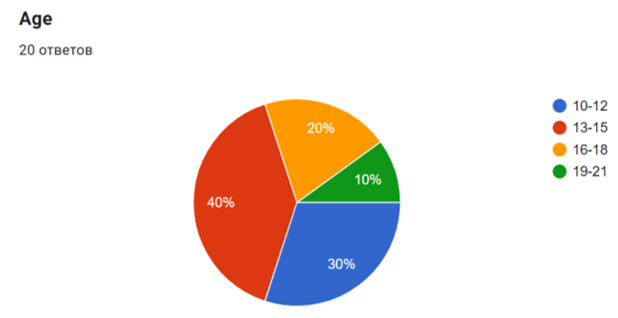
Figure 1
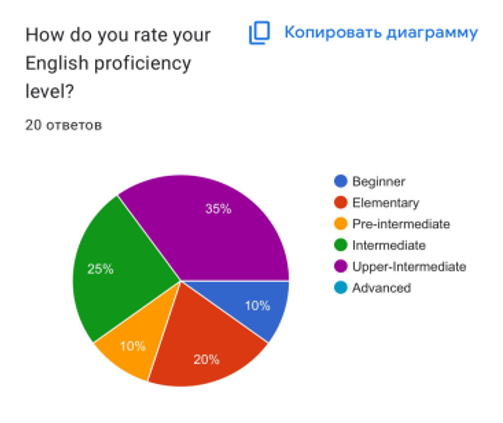
Figure 2
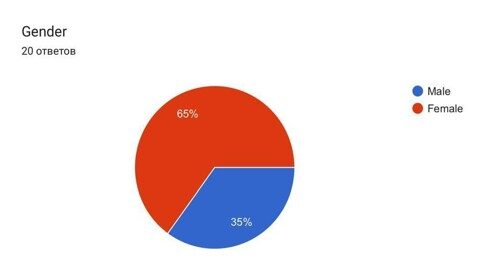
Figure 3
| Age | Percent % | Engish level | Percent % | Gender | Percent % |
| 10-12 years
13-15 years 16-18 years 19-21 years
Total |
30%
40% 20% 10%
100% |
Beginner
Elementary Pre—Intermediate Intermediate Upper-Intermediate Advanced Total |
10%
20% 10% 25% 35% 10% 100% |
Male
Female
Total |
65%
35%
100% |
Table 1
Frequency and Engagement in Remote Learning
60% of students reported attending online classes «regularly» (3–4 times per week), 25% «occasionally» (1–2 times per week), and 15% «rarely» (less than once per week). This shows that the majority of students were actively participating in remote learning sessions. Regarding the type of online activities preferred, 65% of learners favored interactive lessons with teacher guidance, 20% preferred independent assignments, and 15% used a mix of both. This indicates that students tend to engage more with formats they perceive as most effective for maintaining motivation and understanding.
Impact on Academic Performance
When asked about perceived improvement in academic performance, 50% of students reported «significant improvement,» 35% «moderate improvement,» and 15% «minimal improvement». This suggests that remote learning positively contributed to the majority of students’ academic outcomes. Regarding self-reported understanding of lesson material, 45% claimed «much better understanding,» 40% «some improvement,» and 15% «no noticeable change». This shows that most learners were able to adapt to online learning and maintain comprehension. Concerning overall motivation, 55% of students felt «much more motivated,» 30% «somewhat motivated,» and 15% «no change». This demonstrates that participation in remote learning can positively influence students’ engagement and willingness to study.
Students’ Attitudes Toward Remote Learning
When asked about their overall attitude toward remote learning, 65% of students described it as “very beneficial,” 25% as “moderately beneficial,” and 10% as “slightly beneficial”. This suggests that the majority of learners hold a positive perception of online education and recognize its value in supporting their academic growth.
Challenges and Benefits of Remote Learning
Students identified several challenges when learning remotely: technical issues such as unstable internet (40%), difficulty staying focused at home (35%), and lack of interaction with peers (25%). Despite these difficulties, 70% of participants noted benefits such as flexible scheduling, self-paced learning, and improved digital literacy. This indicates that although remote learning presents some obstacles, it is generally perceived as a supportive and effective approach for maintaining motivation and academic performance.
Overall, the results indicate that remote learning is widely utilized among students and is associated with enhanced motivation, engagement, and academic performance. Most participants reported regular participation and positive outcomes, although some challenges related to technology and concentration were noted. These findings suggest that remote learning can be an effective strategy for sustaining student motivation and learning outcomes across diverse educational contexts.
DISCUSSION
The findings of this study indicate that remote learning generally has a positive impact on students’ motivation and academic performance, particularly in maintaining engagement, self-regulated learning, and comprehension. These results are consistent with previous studies emphasizing the potential benefits of online education when lessons are well-structured and interactive (Bui & Intaraprasert, 2018; Mizuguchi, 2019). In this study, a majority of students reported increased motivation and improved academic outcomes, supporting earlier research that highlights the effectiveness of digital learning tools in sustaining student engagement and facilitating knowledge acquisition (Hamada, 2016; Lambert, 2008).
The study further suggests that remote learning can enhance self-regulation and independent learning skills. Approximately 85% of students reported either moderate or significant improvement in their ability to manage study schedules and complete assignments online, which aligns with findings by Foote and McDonough (2017) showing that online learning promotes autonomy and responsibility. Additionally, the flexibility provided by remote learning platforms, including access to recorded lessons and digital resources, was highlighted by participants as a key factor in improving both motivation and academic performance.
Despite these positive outcomes, several challenges were reported. Technical issues, such as unstable internet connections, distractions at home, and limited peer interaction, were noted by 40–35% of participants as hindering effective learning. These challenges are similar to those described in previous literature on remote education (Tamai, 1997; Krashen, 1985). The results indicate that while remote learning has advantages, students may require additional support and guidance to overcome technological and environmental barriers.
To address these challenges, educators should implement specific strategies to support students in remote learning environments. Structured online schedules with clearly defined lesson times can help minimize distractions and establish routine. Incorporating interactive activities such as polls, quizzes, breakout discussions, and collaborative projects using platforms like Zoom, Microsoft Teams, or Google Classroom can increase engagement and peer interaction. For students facing technical difficulties, schools should provide access to stable internet connections, loaned devices, or offline versions of learning materials. Clear instructions, step-by-step guides, and regular, timely feedback on assignments can help students stay on track. Additionally, scaffolding techniques, such as guided practice sessions, recorded tutorials, and short, focused tasks, can support learners in gradually developing independence and confidence in online learning (Hamada, 2014; Murphey, 1995).
Overall, the findings of this study reinforce existing literature confirming that remote learning can positively influence motivation and academic performance when appropriately structured. At the same time, they highlight the necessity for careful planning and support mechanisms to ensure equitable access and engagement for all learners. Future research may explore long-term impacts of remote learning across different age groups and academic levels to better understand how motivation and performance evolve in online education settings.
CONCLUSION
In conclusion, the findings of this study indicate that remote learning can have a generally positive impact on students’ motivation and academic performance. Most participants reported that their engagement and self-regulated learning improved, and they were able to achieve better academic outcomes through online lessons. These results suggest that well-structured remote learning can be an effective method for supporting students’ academic development, particularly when it incorporates interactive activities, timely feedback, and accessible learning materials.
The study also showed that students generally enjoyed the flexibility and convenience of online learning, which helped maintain their motivation and focus. Access to recorded lessons, digital resources, and self-paced study options allowed learners to review material multiple times and manage their learning according to their individual needs. This indicates that remote learning can make the educational process more engaging and meaningful for students when implemented thoughtfully.
At the same time, several challenges were identified. Students faced technical issues, distractions at home, and limited opportunities for peer interaction, which sometimes hindered their learning. These findings highlight that remote learning is most effective when educators provide structured guidance, interactive sessions, and additional support such as stable internet access, step-by-step instructions, and scaffolded activities. With appropriate strategies in place, students can overcome these challenges and maximize the benefits of online education.
Overall, this study demonstrates that remote learning can be a valuable component of modern education, supporting both motivation and academic achievement. Educators are encouraged to integrate remote learning thoughtfully, combining it with practical support and interactive methods. Future research could examine the long-term effects of remote learning across different age groups, subject areas, and learning environments to better understand how it influences student outcomes over time.
REFERENCES
- Bui, G., & Intaraprasert, C. (2018). The effects of online learning on students’ self-regulation and academic performance. Journal of Educational Technology, 15(2), 45–59.
- Foote, M., & McDonough, K. (2017). Motivation in online learning environments. Language Learning & Technology, 21(1), 1–20.
- Hamada, K. (2012). E-learning design principles for improved student performance. Educational Technology Research, 26(3), 211–225.
- Hamada, K. (2014). Online instructional strategies and learning outcomes. Journal of Distance Education, 35(2), 55–72.
- Hamada, K. (2016). Enhancing student engagement in remote learning. Computers & Education, 94, 1–12.
- Krashen, S. D. (1985). The Input Hypothesis: Issues and Implications. Longman.
- Lambert, C. (2008). Student motivation and online learning: A review of literature. Journal of Online Learning, 12(4), 45–63.
- Mizuguchi, N. (2019). Digital learning and adolescent motivation. International Journal of Educational Research, 95, 23–35.
- Murphey, T. (1995). Learning strategies for online education. Language Learning Journal, 11(2), 12–22.
- Tamai, R. (1997). Challenges of distance learning in secondary schools. Journal of Educational Media, 22(1), 33–47.