
Мамай Ұлдай
Академик Е.А. Бөкетов атындағы Қарағанды Ұлттық зерттеу университетітінің
Шет тілі: екі шет тілі мамандығының студенті
Аннотация: В современной системе образования обучение иностранному языку не должно сводиться исключительно к усвоению грамматических норм, а должно быть ориентировано на развитие коммуникативной компетенции учащихся. В этом контексте формирование речевых навыков выступает одной из ключевых задач преподавания. Тем не менее, традиционные методы обучения часто имеют репродуктивный характер и не обеспечивают достаточного уровня беглости речи у обучающихся. В связи с этим особую значимость приобретает внедрение интерактивных учебных заданий в образовательный процесс. В статье с научной позиции рассматривается результативность интерактивных заданий в развитии речевых умений учащихся. В рамках исследования анализируется их влияние на коммуникативную активность, уверенность в использовании языка и темп речи обучающихся. Итоги теоретического анализа и практической проверки свидетельствуют о том, что интерактивные формы работы способствуют активизации процесса освоения иностранного языка и дают возможность учащимся накапливать речевой опыт в условиях, максимально приближённых к естественной языковой среде.
Ключевые слова: речевые умения, интерактивное обучение, коммуникативный подход, иностранный язык, языковая компетентность, диалоговое обучение, образовательные технологии.
In the era of globalization, proficiency in foreign languages has become a key priority within modern education systems. Learning a language goes beyond simply acquiring vocabulary and grammar; its effectiveness is determined by the ability to use this knowledge in real communicative contexts. Therefore, the development of students’ speaking skills serves as a crucial indicator of successful foreign language instruction. Nevertheless, in many educational settings, learners face challenges in oral communication despite demonstrating strong grammatical competence. This issue often stems from limited opportunities for meaningful language practice and insufficient conditions for active student engagement in the learning process.
Contemporary pedagogical studies highlight the significant role of interactive learning activities in enhancing students’ language use. These approaches simulate authentic language environments by encouraging learners to participate in dialogue-based communication. During such activities, students are not passive recipients of information but active contributors to the learning process. This not only strengthens their confidence in speaking but also fosters critical thinking and interpersonal skills.
The application of interactive approaches in foreign language teaching methodology has been extensively examined in academic literature. Research consistently shows that the success of language acquisition is closely linked to learners’ active involvement. In their analysis of task-based learning, Gulshan Nayak and Pratek Patel emphasize the importance of meaningful communicative tasks in language development. They argue that reliance solely on rules and exercises is insufficient for developing speaking abilities, as language fundamentally functions as a tool for communication. Consequently, it is essential to engage students in activities that reflect real-life language use. As the authors note, “task-based learning activities provide language learners with a true communication experience” [1, 3448]. This perspective underlines the necessity of combining theoretical knowledge with practical application. Through such tasks, students actively engage in discussions, exchange ideas, and practice asking and answering questions. As a result, their communicative activity increases, and their confidence in using the language grows. Moreover, interactive tasks promote collaboration and contribute to the development of social and communicative competencies. Thus, task-based interactive approaches represent an effective pedagogical tool for developing students’ speaking skills in conditions that closely resemble a natural language environment.
The development of speaking skills remains one of the central issues in foreign language teaching methodology and has been extensively explored by numerous scholars. Among these, Zahir Ahekzai highlights the significant impact of interactive learning activities on students’ linguistic confidence and communicative engagement. His research suggests that traditional teaching approaches often position learners as passive recipients of knowledge, whereas interactive methods transform them into active participants in the educational process. As noted by the scholar, “practical actions based on the active participation of students are particularly effective in the development of speech skills” [2]. This viewpoint emphasizes that language acquisition should not rely solely on memorization or repetition but must involve meaningful communicative practice. Practical tasks stimulate students’ cognitive activity, encouraging them to express opinions, ask questions, and defend their viewpoints. At the same time, such activities enrich learners’ vocabulary, enhance fluency, and improve their ability to apply grammatical structures. Through interactive tasks, students gradually overcome language barriers by engaging in discussions and exchanging ideas, which helps reduce psychological constraints and build confidence in communication. Consequently, these approaches not only intensify the learning process but also foster more natural and effective language acquisition.
The theoretical basis of interactive learning also occupies a prominent place in foreign language pedagogy and has been examined in the works of various researchers, including Samina Omar. She emphasizes that learning formats grounded in active student participation are particularly effective for mastering a language. According to her perspective, students achieve deeper understanding when interactive methods such as group work, discussions, collaborative tasks, and dialogue-based activities are implemented. A key feature of these approaches is the creation of an environment in which learners directly interact with one another. In this context, language functions not merely as an academic subject but as a genuine means of communication. As the researcher concludes, “interactive tasks allow students to develop their speech skills in a natural way” [3]. This supports the idea that language competence is formed through communicative practice rather than mechanical drills. During group activities, students collaborate to solve problems, exchange ideas, and justify their opinions, which increases their speaking activity and fosters critical thinking. Furthermore, discussion-based methods help develop skills such as argumentation, questioning, and responding. As a result, students’ communicative competence improves, enabling them to use a foreign language effectively within real social and cultural contexts.
The significance of interaction-based methods in developing speaking skills is widely recognized in modern language education theory. One of the scholars who has examined this issue in depth is Josè Monterola, who emphasizes that the defining feature of interactive learning lies in engaging students in collaborative language activities. His research demonstrates that in traditional lesson formats, learners often acquire language experience mainly through repeating prepared texts or giving brief responses to teachers’ questions. In contrast, interaction-based tasks promote active communication among students. During such activities, learners exchange ideas, share information, and work together to solve specific problems. According to José Monterola, the primary advantage of interactive methods is their ability to create conditions in which students participate in language use in a natural way. As he notes, “tasks based on interaction increase the communicative activity of students and expand the language experience” [4]. This supports the idea that language competence develops not only through individual practice but also through social interaction. Interaction-based tasks involve learners in dialogue, collaborative discussions, and the exchange of viewpoints, enabling them to use language structures more naturally. Moreover, peer interaction enhances students’ confidence and helps reduce psychological barriers in speaking. As a result, interactive approaches contribute to the effective and sustainable development of speaking skills.
The integration of interactive methods into the educational process is also regarded as a powerful pedagogical tool for increasing students’ motivation to learn. In contemporary educational theory, motivation is considered a key factor influencing learning outcomes, as students’ interest and active engagement directly affect their academic success. From this perspective, interactive activities make lessons more dynamic and enhance both the emotional and intellectual involvement of learners. These methods transform students from passive listeners into active participants in the learning process. Interactive tasks encourage learners to express opinions, ask questions, engage in dialogue, and collaborate in group work. Consequently, the learning environment becomes more engaging, and students’ interest in the subject increases. Researcher Jorge Saura highlights the strong impact of interactive approaches on students’ learning activity. He notes that such methods not only improve attendance rates but also contribute significantly to the development of language skills. As he states, “interactive methods significantly increase the level of attendance of students” [5]. This finding indicates a close connection between motivation and active participation in the learning process. Furthermore, interactive tasks foster creative thinking and provide opportunities for students to express their own ideas. At the same time, these approaches strengthen peer interaction and help create an authentic language environment. Ultimately, they lead to increased student engagement and the systematic development of speaking skills and communicative competence.
Research methods: The study employed pedagogical control, comparative analysis, and the organization of practical training. During the control phase, two groups of students were compared: one group was taught using interactive activities, while the other followed traditional teaching methods. Interactive techniques included role-playing, discussions, group dialogues, interviews, and situational tasks. These activities were specifically designed to develop students’ speaking experience in contexts that closely resemble real-life communication.
Research results: The implementation of interactive activities during practical training led to a noticeable increase in students’ speaking activity. The use of role-playing tasks in particular helped learners develop their ability to construct dialogues. For instance, in a role-play scenario based on the topic “meeting at the airport,” students acted out a conversation between a passenger and an airport employee. This task enabled them to engage in language use that mirrors real-life interactions.
In another case, a situational task titled “shopping in a store” was applied. During this activity, students took on the roles of buyer and seller, practicing communicative actions such as asking and answering questions, as well as negotiating. As a result, improvements were observed in both the fluency of speech and the learners’ confidence in using the language.
The group discussion method also proved to be effective. While discussing the topic “the advantages and disadvantages of social networks,” students presented arguments and defended their viewpoints. This activity not only enhanced their critical thinking skills but also contributed to the further development of their speaking abilities.
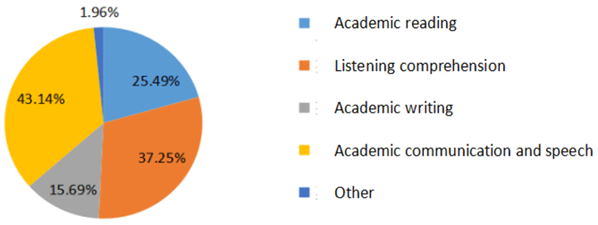
Figure 1: the diagram shows the proportion of academic language skills: academic communication and speech – 43.14%, listening comprehension – 37.25%, academic reading – 25.49%, academic writing – 15.69%, and other skills – 1.96%.
Discussion. The findings of the study confirm that interactive activities are highly effective in developing students’ speaking skills. Such methods promote active participation in the learning process and significantly broaden learners’ language experience. Moreover, interactive approaches enhance students’ communicative confidence and help reduce language barriers that often hinder oral expression.
In addition, interactive tasks contribute not only to the acquisition of linguistic knowledge but also to the development of social skills. Through group work, students exchange ideas, collaborate, and learn to make collective decisions. This, in turn, improves the socio-psychological effectiveness of the educational process and fosters a more supportive learning environment.
Conclusion. The study demonstrates that interactive activities play a crucial role in the development of students’ speaking abilities. These methods increase learners’ language activity and enable them to gain communicative experience in conditions that closely resemble natural language use. The consistent application of interactive approaches can significantly enhance the quality of foreign language teaching and support the development of students’ communicative competence.
References:
- Nayak G., Patel P. Developing speaking skills through task-based learning in English as a foreign language classroom // The Scientific Temper. – 2024. – Vol. 15, №4. – P. 3447–3452. – URL: https://scientifictemper.com/index.php/scientifictemper/article/view/55 (қаралған күні: 06.03.2026).
- Achekzai Z. A study on practical activities that promote students’ speaking skill // Randwick International of Social Science Journal. – 2025. – URL: https://www.randwickresearch.com/index.php/rissj/article/view/1159 (қаралған күні: 06.03.2026).
- Omar S. F. Interactive language learning activities for learners’ speaking skills // Journal of Language Teaching. – 2020. – URL: https://files.eric.ed.gov/fulltext/EJ1274774.pdf (қаралған күні: 06.03.2026).
- Monterola J. M. Interaction-based activities in the teaching of speaking // Open University Journal of Science. – URL: https://journalofscience.ou.edu.vn/index.php/soci-en/article/download/3453/2412/22107 (қаралған күні: 06.03.2026).
- Saura H. J. Enhancing students’ engagement and speaking skills through interactive activities // Asshika Journal. – 2025. – URL: https://jurnal.saniya.id/asshika/article/download/435/325 (қаралған күні: 06.03.2026).