
UDC 372.881.111.1
Мавланова Айсана
Академик Е.А. Бөкетов атындағы Қарағанды Ұлттық зерттеу университетітінің Шет тілі:екі шет тілі мамандығының студенті
Аннотация: процесс обучения иностранному языку в современной системе образования не должен ограничиваться лишь усвоением грамматических правил, а должен быть направлен на формирование коммуникативной компетенции обучающихся. С этой точки зрения развитие речевых навыков является одной из основных целей преподавания иностранного языка. Однако традиционные методы обучения нередко носят репродуктивный характер и не способны в полной мере сформировать у учащихся беглость речи. Поэтому использование интерактивных учебных заданий в образовательной практике приобретает особую актуальность. В данной статье с научной точки зрения анализируется эффективность интерактивных заданий в развитии речевых навыков учащихся. В ходе исследования рассматривается влияние интерактивных методов на коммуникативную активность, языковую уверенность и скорость речи обучающихся. Результаты теоретического анализа и практического контроля показывают, что интерактивные виды деятельности активизируют процесс овладения иностранным языком и позволяют учащимся формировать речевой опыт в условиях, приближенных к естественной языковой среде.
Ключевые слова: речевые навыки, интерактивное обучение, коммуникативный метод, иностранный язык, языковая компетенция, диалогическое обучение, образовательные технологии.
In the context of modern globalization, mastering foreign languages is one of the strategic tasks of the education system. Language learning is not limited to the accumulation of lexical and grammatical knowledge, but is measured by the ability to apply it in specific communicative situations. From this point of view, the development of students ‘ speech skills is one of the main indicators of teaching a foreign language. However, in many educational practices, students experience difficulties in oral communication, even though they perform grammatical tasks correctly. This problem is associated with the insufficient organization of language practice in the educational process and the lack of conditions for the active participation of students.
Modern pedagogical research shows that interactive educational activities play a special role in increasing the language activity of students. Such methods create a situation close to the language environment by involving students in dialogical communication. In the course of interactive activities, students become not only listeners, but also active participants in the learning process. This approach allows not only to increase the speech confidence of students, but also to develop their skills of critical thinking and social interaction.
The problem of using interactive approaches in the methodology of teaching a foreign language is considered in detail in many scientific works. Modern pedagogical research shows that the effectiveness of the language learning process is directly related to the active participation of the student. Analyzing the theory of task-based learning, Gulshan Nayak and Pratek Patel note that specific communicative tasks play a special role in mastering a foreign language. According to scientists, mastering language material only through rules and exercises cannot fully form the speech skills of students, since language is primarily a means of communication. Therefore, in the learning process, it is important that students participate in language situations similar to real life. In their work, the authors argue that «task-based learning activities provide language learners with a true communication experience» [1, 3448]. This point of view indicates the importance of mastering language knowledge not only at the theoretical level, but also through practical application. In the course of such tasks, students actively participate in language activities by discussing a particular problem, exchanging ideas, asking or answering a question. As a result, the speech activity of students increases and their linguistic confidence is formed. In addition, interactive tasks involve students in joint work and contribute to the development of their social and communication skills. From this point of view, task-based interactive approaches in teaching a foreign language are an effective pedagogical tool for the formation of students ‘ speech experience in conditions close to the natural language environment.
The problem of developing speech skills is one of the most important areas of the methodology of teaching a foreign language, and this issue is widely considered in the works of many researchers. One of the studies in this direction is reflected in the works of Zahir Ahekzai. The scientist emphasizes that interactive educational activities have a direct impact on the language confidence and communicative activity of students. In his research, it is argued that traditional teaching methods often lead to students being trapped as passive listeners, while interactive approaches, on the contrary, make them active participants in the learning process. According to Zahir Ahekzai, «practical actions based on the active participation of students are particularly effective in the development of speech skills» [2]. This conclusion indicates that in the process of mastering a foreign language, it is necessary for students to form language skills not only through the repetition of the finished text, but also through specific communicative actions. Practical tasks increase the mental activity of students, motivate them to make an opinion, ask questions and defend their point of view. At the same time, such activities expand the language base of students, improve the speed of speech and skills in using grammatical structures. In the course of interactive practical tasks, students begin to gradually overcome the language barrier, exchanging ideas and participating in group discussions. As a result, the psychological barriers encountered in speech are reduced, and students ‘ linguistic confidence is formed. Such approaches not only intensify the educational process, but also form natural and effective ways to master a foreign language.
The theoretical foundations of interactive educational activities occupy an important place in the methodology of teaching a foreign language, and this issue has been analyzed in the works of many researchers. One of the scientific studies in this direction is reflected in the works of Samina Omar. The scientist emphasizes that in the process of language learning, forms of learning based on the active participation of students are particularly effective. In his opinion, in the learning process, students will learn more deeply the language material if interactive approaches are used, such as group work, discussion, joint tasks and dialogue activities. Samina Omar shows that the main feature of interactive methods is that they create conditions for students to interact directly with each other. In such a situation, language is used not only as an academic subject, but as a real means of communication. In his work, the researcher concludes that «interactive tasks allow students to develop their speech skills in a natural way» [3]. This conclusion proves that in the process of mastering a foreign language, language skills are formed not through mechanical exercises, but through communicative activity. In the course of group work, students try to jointly solve problems, exchange ideas and prove their point. Such educational activities not only increase the speech activity of students, but also develop their critical thinking. At the same time, the discussion method forms students ‘ skills of argumentation, questioning and answering. As a result, the communicative competence of students develops, and they begin to use a foreign language in a specific social and cultural context.
The importance of interaction-based methods in teaching speech is one of the areas that is given special attention in the theory of Modern Language Education. Jose Monterola, one of the scientists who has studied this issue in detail, emphasizes that the main feature of interactive learning is that it allows students to engage in joint language activity. His research shows that in traditional lesson models, students often gain language experience only by repeating a finished text or giving a short answer to a teacher’s question. And tasks based on interaction ensure that students enter into active communication. In the course of such tasks, students exchange ideas with each other, share information and try to jointly solve a particular problem. According to José Monterola, the main advantage of interactive learning methods is that they create conditions for students to participate in language activity in a natural way. In his work, the scientist notes that «tasks based on interaction increase the communicative activity of students and expand the language experience» [4]. This conclusion proves that the formation of language skills occurs not only through individual exercises, but also in the course of social communication. Tasks based on interaction involve students in dialogue, joint discussion and exchange of views. Such actions make it possible to use language structures in speech in a natural way. At the same time, the interaction of students with each other increases their linguistic confidence and reduces the psychological barriers they face when speaking. As a result, interactive learning approaches contribute to the effective and stable formation of speech skills.
The use of interactive methods in the educational process is considered one of the most important pedagogical tools for increasing the motivation of students to study. In modern educational theory, motivation is considered as one of the main factors in the effectiveness of learning, because the interest and active participation of the student directly affects the learning outcome. In this sense, interactive activities revitalize the content of the lesson and strengthen the emotional and intellectual participation of students in the learning process. Such methods form students during the lesson not only as listeners, but also as active participants in educational activities. Interactive tasks encourage students to comment, ask questions, conduct a dialogue, and participate in teamwork. As a result, the educational process becomes dynamic, and students ‘ interest in the lesson increases. Jorge Saura, who studied this issue, shows that interactive learning approaches have a significant impact on the learning activity of students. The scientist notes that interactive activities not only increase the level of attendance of students, but also contribute to the development of their language skills. In his opinion, «interactive methods significantly increase the level of attendance of students» [5]. This conclusion suggests that active participation and motivation in the process of learning are closely related. Interactive tasks develop students ‘ creative thinking and allow them to express their own opinion. At the same time, such approaches strengthen the interaction of students and create conditions for the formation of a language environment. As a result, students ‘ interest in the lesson increases, speech activity and communicative competence are systematically developed.
Research methods: in the course of the study, methods of pedagogical control, comparative analysis and organization of practical training were used. During the Control Period, two different study groups were compared, in which interactive activities were used and traditional methods were used. Role-playing games, discussion, group dialogue, interviews and situational tasks were used as interactive methods. These activities were aimed at forming students ‘ speech experience in real communication situations.
Research results: the use of interactive activities in the course of Practical Training showed a significant increase in the speech activity of students. The use of role-playing games during the lesson allowed students to develop the ability to build a dialogue. For example, in the role-playing task on the topic» meeting at the airport», students performed a dialogue between a passenger and an employee. This task allowed students to perform language actions similar to real-life situations.
In another example, the situational task «buy in a store» was used. During this task, students performed the role of seller and buyer, performing language actions such as asking questions, answering and negotiating. As a result, it was observed that the speed of speech and language confidence of students increased.
The group discussion method also showed effective results. During the discussion on the topic» the benefits and harms of social networks», students tried to prove their point and put forward arguments. This activity not only developed their critical thinking, but also contributed to the improvement of speech skills.
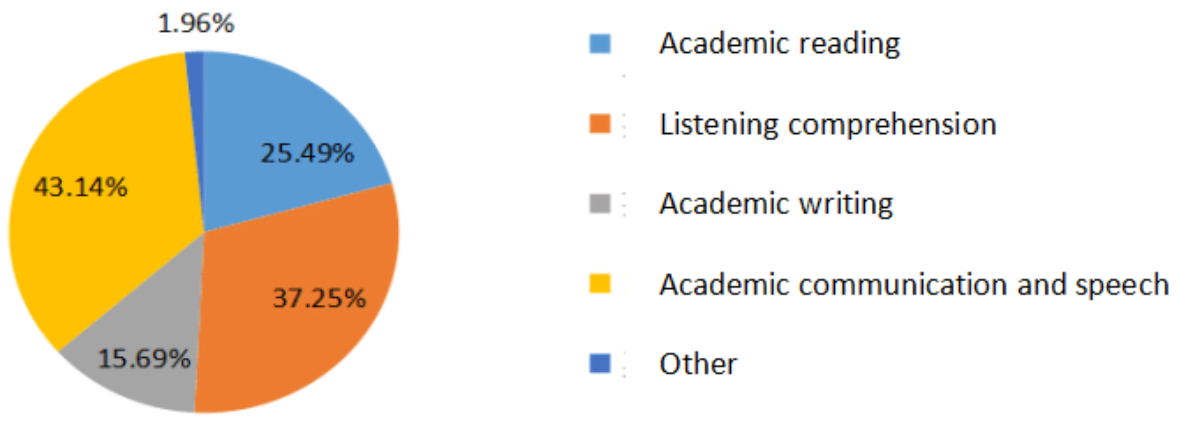
Figure 1: the diagram shows the proportion of academic language skills: academic communication and speech – 43.14%, listening comprehension – 37.25%, academic reading – 25.49%, academic writing – 15.69%, and other skills – 1.96%.
Discussion. The results of the study prove that interactive activities show high efficiency in the development of speech skills. Interactive methods ensure that students are actively involved in the lesson and expand the language experience. At the same time, such approaches increase the communicative confidence of students and reduce the language barrier.
Interactive tasks allow students to develop not only language knowledge, but also social skills. In the course of group work, students exchange ideas with each other and learn to make joint decisions. This, in turn, increases the socio-psychological efficiency of the educational process.
Conclusion. The conducted study showed that interactive activities play an important role in the development of students ‘ speech skills. Such methods increase the linguistic activity of students and allow them to form a speech experience in conditions close to the natural communication environment. The systematic use of interactive approaches will improve the quality of teaching a foreign language and contribute to the development of communicative competence of students.
References:
1. Nayak G., Patel P. Developing speaking skills through task-based learning in English as a foreign language classroom // The Scientific Temper. – 2024. – Vol. 15, №4. – P. 3447–3452. – URL: https://scientifictemper.com/index.php/scientifictemper/article/view/55 (қаралған күні: 06.03.2026).
2. Achekzai Z. A study on practical activities that promote students’ speaking skill // Randwick International of Social Science Journal. – 2025. – URL: https://www.randwickresearch.com/index.php/rissj/article/view/1159 (қаралған күні: 06.03.2026).
3. Omar S. F. Interactive language learning activities for learners’ speaking skills // Journal of Language Teaching. – 2020. – URL: https://files.eric.ed.gov/fulltext/EJ1274774.pdf (қаралған күні: 06.03.2026).
4. Monterola J. M. Interaction-based activities in the teaching of speaking // Open University Journal of Science. – URL: https://journalofscience.ou.edu.vn/index.php/soci-en/article/download/3453/2412/22107 (қаралған күні: 06.03.2026).
5. Saura H. J. Enhancing students’ engagement and speaking skills through interactive activities // Asshika Journal. – 2025. – URL: https://jurnal.saniya.id/asshika/article/download/435/325 (қаралған күні: 06.03.2026).